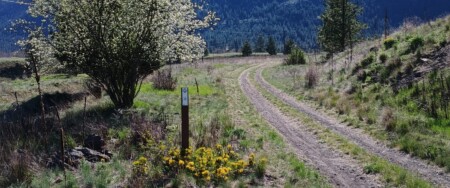


The Boundary region of the Trans Canada Trail in Trails BC is exclusively situated on rail trails. Starting from the western side, the region connects with the Okanagan at the highest point between McCullough and Summit Lakes on the Kettle Valley Railway, just east of the Myra Canyon. This particular section of the KVR spans approximately 125 km and runs south, leading to the town of Midway.
At Midway, the KVR concludes and the Columbia & Western Railway (C&W) commences. This rail trail stretches around 77 km towards the east, eventually reaching Christina Lake. The segment between Nursery Trestle east of Grand Forks, spanning 17 km to Cascade Trestle.
This trail surface is no longer accessible to all individuals for walking and cycling due to damage from unregulated OHVs, heavy precipitation and run off and lack of trail surface maintenance. It has a variable trail surface and has ballast, rocks, ruts and sand to contend with. In 2017, a 17 km section of designated non-motorized trail was improved with a couple kms of asphalt and crush between Grand Forks and Cascade West. This section was invested in by the Province of BC because it was officially designated “non-motorized.” It is much easier for people with mobility scooters and those living with hidden disabilities.
For the latest updates on the work being done by the Grand Forks Community Trails Society on this rail trail section, you can click here. Beyond this point, the Trans Canada Trail continues north on the C&W, gradually gaining elevation for another 35 km until reaching Farron Summit, where the Boundary region intersects with the West Kootenay region. The C&W continues for an additional 45 km to Castlegar.
There is some deterioration of the trail surface. Trail users are encouraged to plan for a challenging and rewarding journey. We highly recommend bicyclists to use sturdy equipment on the trail. Mountain bikes are the most suitable, but a sturdy hybrid bike will be lighter, which is important when traveling long distances. Front suspension is not necessary but can increase comfort on uneven sections.
Tire width should be a minimum of 35-38mm, and wider tires, although slower, will be beneficial when encountering deep sand. As the trail was originally a railway, there are no steep inclines. Snow can linger on the trail near Farron (north of Christina Lake and the Paulson bridge) until mid-May on north-facing slopes. We suggest wearing gloves, in addition to a helmet, as cyclists may lose their balance on soft sand and experience the occasional fall. As an alternative to the C&W from Christina Lake to the West Kootenay region, many hikers, equestrians, and even some mountain bikers may opt to travel east for 37.5 km towards Rossland on a section of the historic Dewdney Trail for a more backcountry experience. Trail conditions vary depending on maintenance, but users should anticipate a more challenging journey compared to the rail trail. It’s important to note that the Dewdney Trail is not officially designated as part of the Trans Canada Trail. Additionally, it is not suitable for bicyclists carrying trailers or panniers.
Traveling parallel to the Dewdney Trail (and occasionally crossing it) is the Cascade Highway. Despite its name, the Cascade Highway is not a modern-day highway. It replaced the Dewdney Trail in 1922 but was subsequently replaced by Highway 3. The Cascade Highway can be navigated with a hybrid bicycle or a well-equipped support vehicle, preferably with 4-wheel drive. Travelers should still be prepared for challenging road conditions and a long, dusty trip.
This southern corridor, the Boundary region meets the West Kootenay region at the Santa Rosa Summit, which marks the highest point of the Dewdney Trail. This region is in the territory of the Okanagan and Ktunaxa people who have been caretakers of the land since time immemorial.
Looking to learn more about this region?
Home – Boundary Country – BC Canada (boundarybc.com)
limləmt, hu sukiⱡq̓ukni, thank you