
Kwikwetlem FN adjoining Colony Farm Regional Park along the Coquitlam River.
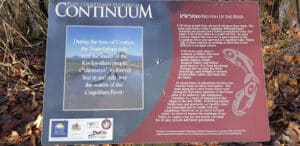
kwikwaxǝm RED FISH UP THE RIVER – the Coquitlam River between what is now known as Coquitlam and Port Coquitlam.
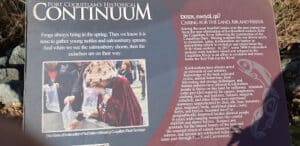
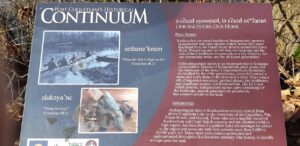
The following excerpts come from Port Coquitlam’s Historical Continuum found on 3 panels along the PoCo Trail along the Coquitlam River on both sides of the railroad crossing the River where the well-displayed and complete text and panels are worth taking in.
kwikwaxǝm people have always lived upon these lands. The name, kwikwǝkǝm, refers to a small red fish – an early sockeye salmon that once ran in great number in the Coquitlam River and spawned in Coquitlam Lake. Elders talk of these sockeyes as running so thick that it was difficult to navigate canoes.
kwikwǝkǝm comes from a tradition of Elders who were renowned as canoe and paddle makers, master sturgeon fishers, and skilled spirit dancers. As they move forward today, they strive to honor the teachings of our Elders to respect, care for and protect our lands for all past, present, and future generations.
Kwikwetlem people are proud traditional hən̓q̓əmin̓əm̓ speakers. It was once spoken widely across the Lower Mainland from the Fraser River delta to around the Stave River. Celebrating place names is an important step in language revitalization. Dozens of hən̓q̓əmin̓əm̓ place names dot the landscape of the lower Coquitlam River floodplain. As recalled by the older generations, every hill carried a name and every bend in the river told a story. Place names tell of important resources, spirited places, key landforms, and significant events. Like all Coast Salish peoples hən̓q̓əmin̓əm̓ names carry knowledge of the landscape, passed from generation to generation, that connects people to the land.
Archaeological sites in Kwikwetlem territory extend from above Coquitlam Lake to the shorelines of the Coquitlam, Pitt, and Fraser Rivers, and beyond. These sites are a tangible record of Kwikwetlem and Coast Salish ancestry and are locations held in high regard. Artifacts from Coquitlam Lake are amongst the oldest in the region and associate with time periods more than 8,000 to 10,000 years old. Many more sites remain undetected and undocumented throughout Kwikwetlem territory.
Among the most heartfelt losses over th
e past century has been the near elimination of Kwikwetlem sockeye from the Coquitlam River following the construction of the Coquitlam Dam. Having watched this run driven nearly to extinction, today, Kwikwetlem people are leaders in stewardship efforts to revitalize and return home the kwikwǝkǝm sockeye. In 2017, some 5000 Kwikwetlem sockeye were hatchery-raised and released to the Coquitlam River in an effort to revitalize and return home the Red Fish Up the River.
Kwikwetlem people have always acted as stewards of their territory. Knowledge of the land, seasonal cycles, animal behavior, food harvesting, and storage techniques, and habitat patterns have allowed Kwikwetlem people to thrive on this land for millennia. Abundant cedar provided material for canoes, longhouses, clothing, tools, and basketry. Salmon, sturgeon, eulachon, and other fishes were nutritional mainstays supplemented by deer, elk, bear, mountain goat, migratory birds, medicinal plants, roots, herbs, and berries. Seasonal travel to geographically dispersed locales allowed people to enjoy wide-ranging resources like coastal shellfish and alpine berries. Respect and gratitude for the natural bounty of the land and the seasonal return of valued resources like elk, salmon, and sprouts are celebrated today as in times past through Fast Food Ceremonies.