

Juan de Fuca Marine Hiking Trail
Juan de Fuca Provincial Park on the west coast of southern Vancouver Island offers scenic beauty, spectacular hiking, marine and wildlife viewing and roaring surf in its course along the Pacific coastline of the Strait of Juan de Fuca. A major feature of this park, the Juan de Fuca Marine Trail, is approximately 42 kilometres of wilderness trekking along the rugged shoreline. Although most of the Juan de Fuca Marine Trail is designed for strenuous day or multi-day hiking/camping in this rugged and isolated area, some easy to moderate day hiking opportunities to the beach or along the trail are available starting from the trailheads.
The hike normally takes 3-4 days. There are no services along the route – travellers should come prepared for the remote experience. Backcountry passes for camping must be purchased from BC Parks. A shuttle service to/from Port Renfrew and China Beach (as well as Victoria) is available during the summer months (see “Transportation” below).
A common question hikers ponder is, “Which direction should I do the hike?”
- Transportation logistics (how are you getting to the trailhead? Will you be leaving a car, or relying on meeting a bus at the other end?)
- Tidal cut offs and beach walking (it is essential to plan ahead for some of the high-tide beach cutoffs – will you direction of travel mean that you will encounter the cut-offs at high tide or low tide? Generally, in the summer months, lowest tides are in the morning and come up through the day)
- Seeing Botanical beach at low tide is nice (will you encounter it at the start – or later in the day if you are finishing there?)
- The dreaded “Bear Beach – Chin Beach” section. It really shouldn’t play as large a role as many people give it, but it’s indeed the most challenging section – do you prefer to get it over with earlier? Or wait until your pack is lighter? A tip would be to do it at the beginning of the day, rather the end. But the items above should probably play a larger role in your decision)
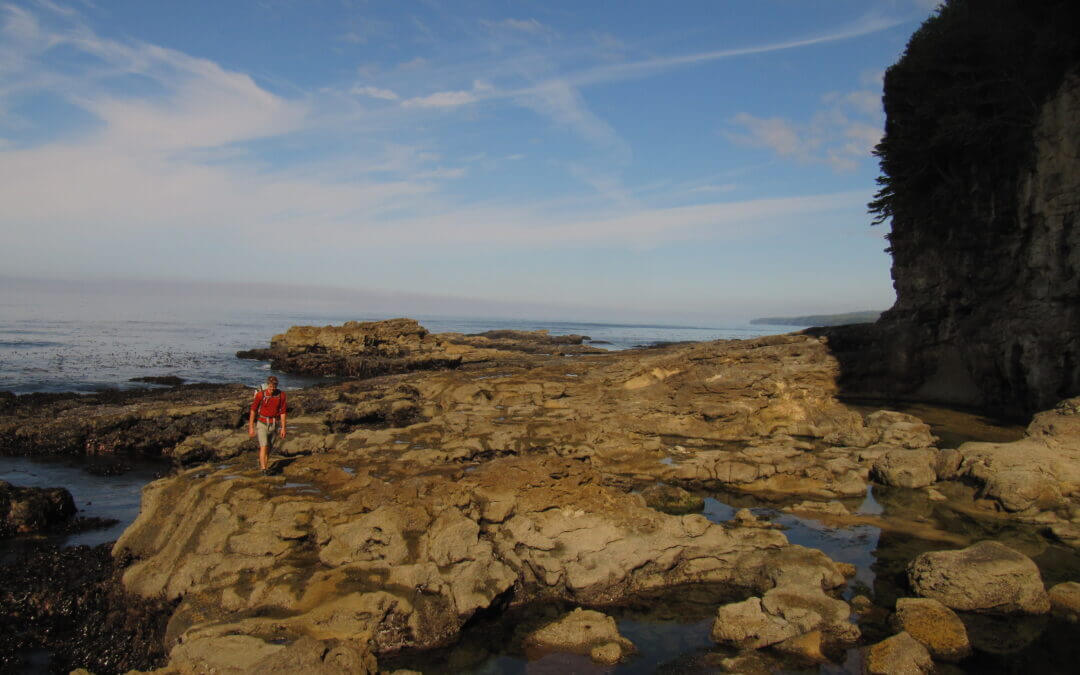
- Botanical beach to Payzant: 2.5 hrs, 7 km. Moderate difficulty but trail condition is generally well worn and easy to follow. Take some extra time to explore; there are lots of shoreline options, but you might reach an impassible surge channel and be forced to bushwack to regain the official trail. Aim for doing this section at low tide – and it is best to not do this alone!
- Payzant Campground: In forest, but good tent sites, pretty river and waterfall, not much of a view but nice afternoon light.
- Payzant to Parkinson trailhead: 1 hr, 3 km. Conditions are moderately difficult.
- Parkinson to Little Kuitshie: 1 hr, 4 km. Very muddy!
- Little Kuitshie Campground: Unimpressive; probably the least charming of all campsites along the trail. Dark, dank forest. Possible hikes towards shoreline access.
- Little Kuitshie to Sombrio (West): 1.5 hrs, 4 km. Moderate difficulty – a little up and down but good conditions. Note high tide beach cut offs!
- Sombrio Breach Campground: There are 3 areas..
- Sombrio Campsite (“West” – west bank of river): Wooden platforms (could be considered good or bad!), lots of day users.
- Sombrio Campsite (“Centre” – just east of river): Can be a busy place with day users but great sites, possibility of grass set up.
- Sombrio Campsite (“East” – around the corner in the next bay): Quiet, sand sites. Recommended. Hidden waterfall (halfway between the bear cache/outhouse and about 20 metres west from where the trail leaves the beach to climb uphill, there is a little unassuming creek that flows onto the beach and dissolves into the sand (48.4935° -124.2947°) – follow the path up the river!). Also, interesting rock formations/collapsed seacave at eastern end of beach (48.4921° -124.2935°).
- Sombrio West to Sombrio East: 0.5 hr, 2 km. Beach walking
- Sombrio East to Sombrio Point: 0.5 hr, 1 km. Quite difficult! Travellers heading west might feel discouraged as they can see Sombrio but face tricky terrain and mud! Hang in there!
- Sombrio Point to Loss Creek Bridge: 1 hr, 2 km. Big elevation gain to an old logging road (nice and flat!), then drop. But the ascent/descent is not too steep. Take your time and enjoy some large trees.
- Loss Creek Bridge to Chin Beach: 1 hr, 3 km. Moderate difficulty overall and enjoyable. The last bit of trail into Chin cannot be hiked at high tide – there is no alternate!
- Chin Beach Campground: Very nice campsite, not too many sites, but outlook and beach is nice and sites are tucked in trees. Possible hike to see large trees – uphill of campsite and shelter, possible loop. Do note beach cut offs at high tide!
- Chin to Bear: 3.5 hrs, 12 km. This section is the most difficult with lots of elevation change – but all elevation changes are 70 metres or less, except for Hoard Creek which is 100 m.
- Bear Beach campground: Westernmost campsite is lousy (best for overflow), Centre (Clinch creek) sites are lovely (small ravine, cleared sites, shade). East campsite (at Rosemond Creek, past sand bluff) are nice but gets filled up early. This site is also close to breaking waves sometimes, so could feel a little exposed during storms or high winds. A nice waterfall is located just to the east – but the trail goes past it, so everyone gets to see it eventually.
- Bear Beach to Mystic Beach: 2.5 hrs, 7 km. Plenty of up-and-down, but pleasant forest and well worn trail with not much mud.
- Mystic Beach Campground: Stunning beach and great walks at low tide, but limited sites and feels exposed when surf is up. Only 2 km from trailhead so lots of day users, but quiets down in afternoon.
- Mystic Beach to China Beach: 0.5 hr, 2 km. Very easy and straightforward.
Please do make a note of the 6 locations (shown on our map) of “high tide cut offs”. The BC Parks map also includes information on these cut offs. If you arrive to the cut offs and the tide is above the cut off height, you won’t be able to pass. And it’s even possible that you’ll still need to remove your shoes and socks and wade through the water even if you arrive at a tide below the cut off – there may be waves. See our map for details, or the BC Parks map (link below).
Recent Comments