
While not an official Trans Canada Trail alternate route at this time, this route is meant to connect the TCT in Langley with the Lochside Trail to Victoria. It offers a shorter route on the TCT in and out of Victoria to the Lower Mainland and vice versa.
The 61-km Alternate Route described here connects back to the main route of the Trans Canada Trail at the Golden Ears Bridge in Langley via Delta and Surrey. Mainly off-road routes are also possible to connect back to the City of Vancouver to rejoin the main route of the TCT.
This corridor connects regional greenways, municipal and regional parks, and forests taking advantage of dikes and utility rights of ways.
From the Tsawwassen Ferry terminal one is pleasantly greeted by a causeway with the Salish Sea washing up on both sides. Next is the Tsawwassen FN with its breakwater, half km boardwalk over marshland, the reserve itself, and finally the huge Tsawwassen Mills commercial centre. East of downtown Tsawwassen, the 16-km dike Boundary Bay Greenway overlooks a large bay all the way to White Rock and Bellingham in the United States. Bird watchers abound on these dikes. The dikes run into Mud Bay Regional Park, again a great bird watching area with wetlands. From there heading north the route takes in the Delta-South Surrey Greenway with its Watershed Park and the edge of the famous Burns Bog.
Through Surrey the trail mainly follows a hydro right-of-way and passes through Green Timbers Urban Forest to later experience Tynehead Regional Park.
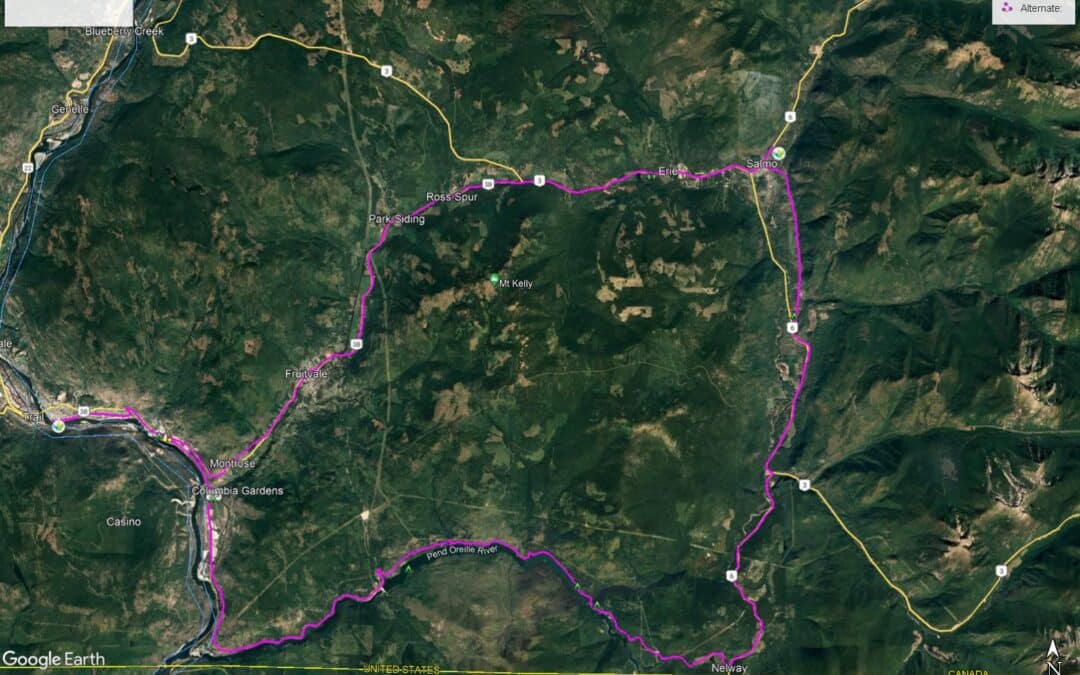
The route between Trail and Salmo is not part of the Trans Canada Trail. However, for those travelling from Castlegar south to Trail, the two routes described here will allow one to connect to the southern terminus of the Salmo Great Northern Railway for a pleasant ride north to Nelson. This can be a suitable route for bicyclists who have chosen not to take the “main route” of the Trans Canada Trail from Castlegar directly to Nelson via the Skattebo Reach and Ward’s Ferry Trail, both of which are unsuitable (and not permitted) for cyclists at this time.
Our two favoured alternate routes connecting Trail and Salmo are either A) Following Highway 3B through the Beaver Valley via Montrose and Fruitvale, or B) taking a journey further south to the Pend Oreille River, then returning north again from Nelway to Salmo on Highway 6. Much of this route is on unpaved roadways.
For those travelling to Salmo via the Beaver Valley, the route leaving Trail on Highway 3B begins with a long climb up the mountainside to Montrose and Fruitvale – however, it is the only substantial hill on the route. The rest of the highway to Salmo is otherwise fairly flat and simple to follow.
The Pend Oreille is a quieter and longer route. It can be quite hot and dusty at times, but it surely a more memorable adventure.
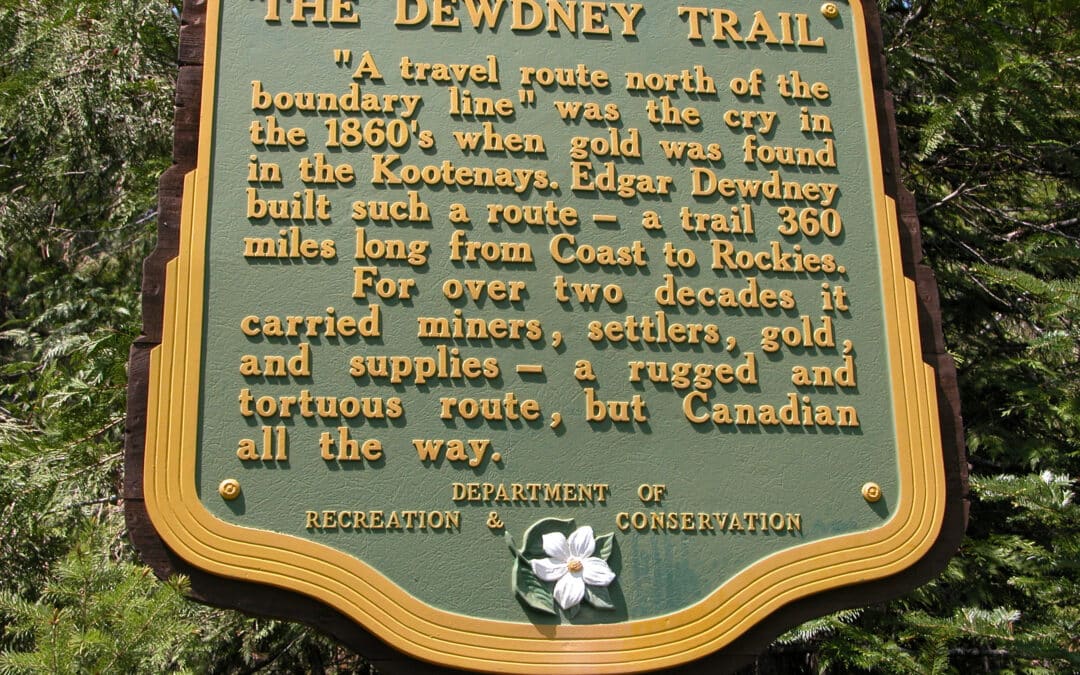
The Dewdney Trail is a historic hiking/equestrian trail that follows the route used by miners and settlers in mid-19th century British Columbia. However, only a few sections of the trail remain in operation as recreational trails, including this short portion between Santa Rosa Road (Christina Lake) and Highway 22 (Rossland), which is registered as a non-motorized recreational trail by the BC Ministry of Forests (MFLNRO, Recreation Sites and Trails BC Branch). This portion of the Dewdney is 37.5 km in length and generally is an overnight hike.
Note: Our GPS tracks for the Dewdney Trail are not considered to be 100% accurate. Use at your own risk. You will notice up to three separate GPS tracks braiding along the Dewdney trail on our map; they are all from separate sources – and we have posted all three, not really knowing which (if any) are the most accurate. One is from the Ministry of Forests, while another is from OpenStreetMaps (an open source online map). A third that travels just the eastern 1/3 of the trail is supplied by the Kootenay Columbia Trails Society. We welcome your feedback – and invite anyone to send us their own GPS tracks to help us improve the accuracy. Again, please note that all tracks are “use at your own risk” (see our Disclaimer above for more details).
The Dewdney Trail is crossed many times along its length by its successor, the Cascade Highway, which was opened in 1922 and allowed travellers to drive motor vehicles over the Monashee Mountains. This gravel roadway has been largely replaced by the Crowsnest Highway, so is mainly used by recreational users – and makes a suitable route for adventure cyclists or support vehicles (4WD recommended) for hikers. It is a 72 km drive with countless hairpin turns and stunning views – but is known to be quite dry and dusty, so carry plenty of water. Our GPS track should be completely accurate.
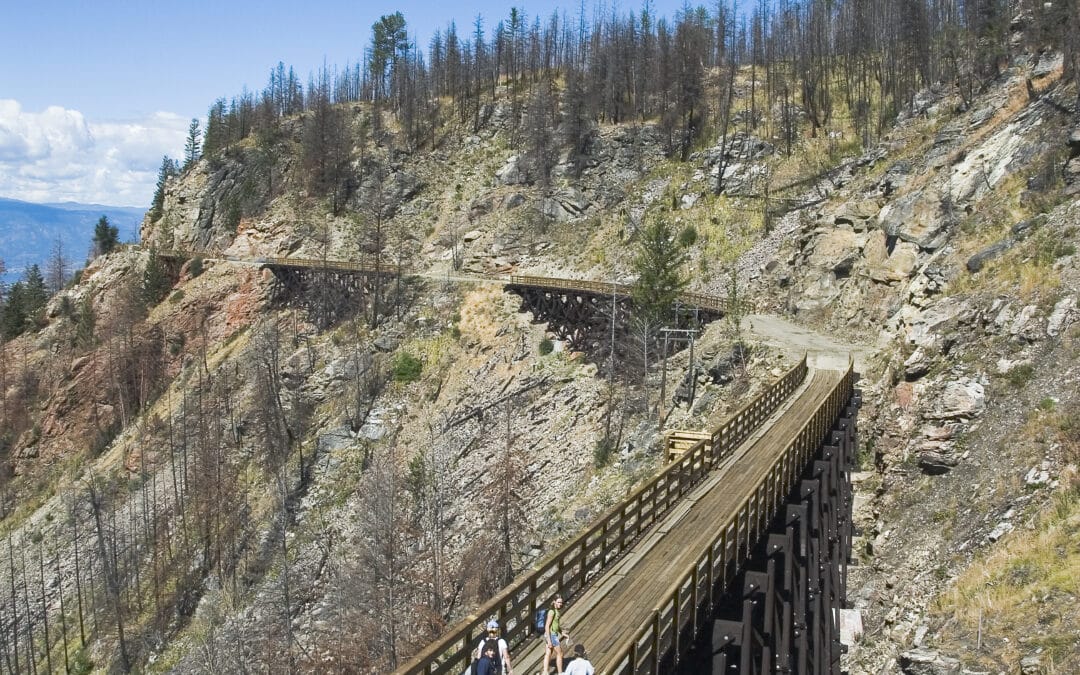
This route makes a great bypass of the Myra Canyon for equestrian trail users – or for everyone when the Myra Canyon becomes temporarily closed.


Recent Comments